
Description
Non-communicable diseases (NCDs), which include heart disease, stroke, cancer, diabetes and chronic lung disease, are estimated to result in over 43 million deaths each year, or 75% of all deaths globally. Of these deaths, about 73% occurred in low- and middle-income countries (LMICs). [1]
Cardiovascular diseases (CVD) accounted for the bulk of these deaths, with 33% all deaths globally, where ischemic heart disease (9.1 million deaths) and stroke (6.6 million deaths) made up 85% of the CVD-related deaths. Of the estimated 20.5 million CVD-related deaths in 2021, approximately 80% occurred in LMICs. [2]
There were an estimated 589 million people with diabetes in the world, a figure likely to reach 853 million by 2050. In India, the estimates were that 89.8 million people had diabetes, projected to rise to 156.7 million by 2050. Globally, there were approximately 3.4 million deaths in adults due to diabetes or its complications, while in India the figure was 0.33 million. [3]
The National Non-Communicable Disease Monitoring Survey (NNMS) reported a similar prevalence of diabetes of 9.3% across India, whereas the ICMR-INDIAB Collaborative Study Group estimated prevalence of diabetes of 11.4% was higher [4], [5].
Further, the prevalence of impaired fasting blood glucose was 24.5% and that of prediabetes was 15.3% in the NNMS and ICMR-INDIAB study respectively.
It is well known that unhealthy diets, physical inactivity and tobacco use, are all risk factors associated with the causation of diabetes as well as CVD.
Associated conditions like hypertension, dyslipidemia and obesity are implicated in increased morbidity and mortality due to diabetes as well as CVD. High rates of hypertension (35·5%), generalized obesity (28·6%), abdominal obesity (39·5%), and dyslipidemia (81·2%) were reported from the ICMR-INDIAB study.
Management of diabetes and CVD poses a major challenge for the healthcare systems due to a shortage of specialists who can treat these conditions. Therefore, there is a need to build the capacity of doctors to address the management of CVD and diabetes, or what is commonly referred to as “cardio-diabetes”.
The “Advanced Certificate Course in Prevention and Management of Diabetes and Cardiovascular Diseases (ACMDC)” is one such effort that aims to strengthen the technical competencies of primary care physicians to better manage diabetes and CVD.
The course has been developed and implemented in collaboration with the Public Health Foundation of India (PHFI), New Delhi.
References:
1. World Health Organization. Noncommunicable diseases; 2025 Sep 25. https://www.who.int/news-room/fact-sheets/detail/noncommunicable-diseases
2. Di Cesare M, Perel P, Taylor S, et al. The Heart of the World. Glob Heart. 2024;19(1):11.
3. Magliano DJ, Boyko EJ, editors. IDF Diabetes Atlas. 11th ed. Brussels: International Diabetes Federation; 2025.
4. Mathur P, Leburu S, Kulothungan V. Prevalence, Awareness, Treatment and Control of Diabetes in India From the Countrywide National NCD Monitoring Survey. Front Public Health. 2022;10:748157.
5. Anjana RM, Unnikrishnan R, Deepa M, et al; ICMR-INDIAB Collaborative Study Group. Metabolic non-communicable disease health report of India: the ICMR INDIAB national cross-sectional study (ICMR-INDIAB-17). Lancet Diabetes Endocrinol. 2023;11(7):474-89.
Course Highlights
- Module-based syllabus incorporating the latest scientific guidelines
- Video lectures by expert faculty for easy understanding
- Case studies and demonstrative videos interspersed across the course
- Interesting activities for the participants
- Pre-test and post-test for each module to assess learning progress
- Online format allows for learning at one’s own pace
- Learning across multiple formats like desktop, laptop, tablet and mobile
- Exit exam at the end of the course, and certificate on course completion
Eligibility Criteria
Doctors (MBBS and above)
Curriculum
- 1. The Association between Diabetes and Cardiovascular Disease
- 2. Vascular Complications and Introduction to Risk Factor Management
- 3. Management of Glycemia with special reference of CVD
- 4. Diabetic Dyslipidemia, Hypertension and Introduction to CAD
- 5. Coronary Artery Disease (CAD), Stroke and Peripheral Arterial Disease (PAD) in Diabetes
- 6. Special Topics and Summary
FAQs
What will I learn from this course?
The course primarily focuses on the macrovascular complications of diabetes, viz. CAD, stroke and PAD. The association between diabetes and cardiovascular risk has been covered in detail. Cardiac testing that aims at cardio–metabolic risk reduction and management at the primary care physician level has been emphasized.
The fundamentals of glycemic management are covered, including use of insulin as well as the newer medications. It also addresses the two important comorbidities, viz. dyslipidemia and hypertension.
A highlight of the course is the attention given to important aspects like diet, exercise and tobacco cessation relevant to the management of both diabetes as well as CAD. Niche areas like bariatric surgery and management of obstructive sleep apnea have been included.
The course addresses several challenging areas to the clinicians, for instance, how to manage diabetes in hospitalized people with heart disease, evaluation and management of people with heart failure and diabetes, etc.
The course would refer to the latest guidelines for management of the conditions discussed above
Who can do this course?
The course is primarily intended for physicians involved in diabetes management and patient education. It is particularly beneficial for primary care physicians (PCPs) who act as the first point of contact for the medical management of people with diabetes.
What is the duration of the course?
The Course has a maximum allowed duration of 6 months, providing flexibility for learners to complete the program within this timeframe.
How will the course be delivered?
The course will be delivered through an online learning program comprising six structured modules. The program combines evidence-based scientific knowledge with real-life clinical learning. Demonstrative videos and interactive case discussions are incorporated to help participants strengthen their practical skills and apply their learning to real-world patient-care situations.
How will I be assessed in this course?
You will be assessed through a combination of pre-tests and post-tests to gauge your progress, along with multiple-choice quizzes after each module. The course concludes with a comprehensive exit exam to evaluate your overall understanding and skills.
What Certificate will I get after I complete the course?
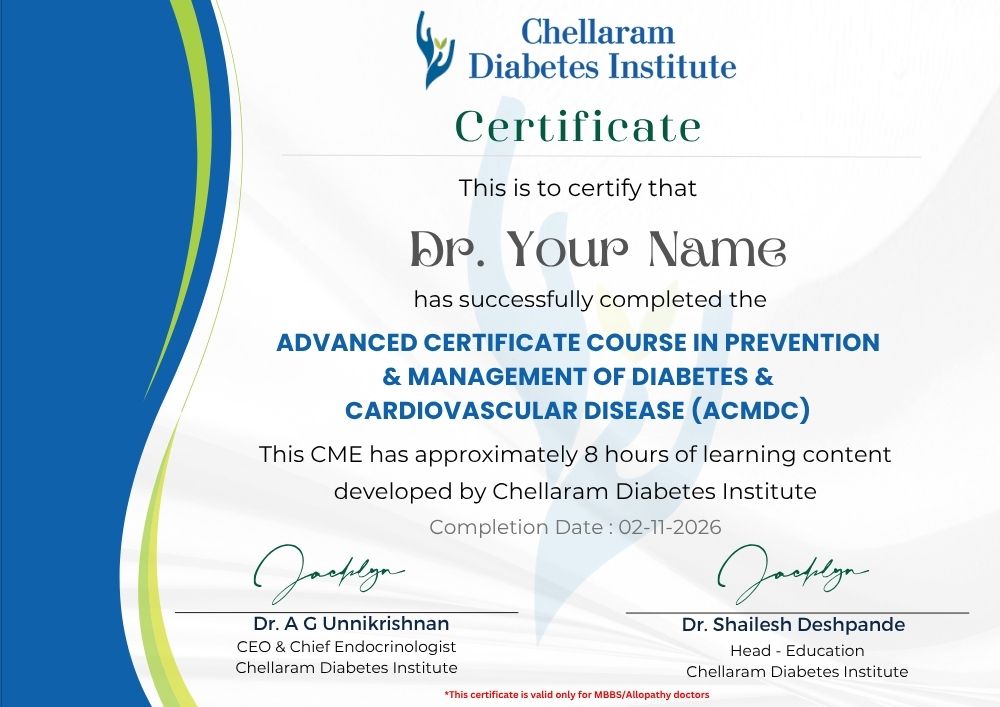
Upon successful completion of the course, you will receive a Certificate from Chellaram Diabetes Institute, recognizing your expertise in the specific area of the course.
Whom can I contact for any support in doing the course?
For any support, you can contact our dedicated support team via WhatsApp, Email, or Phone. Details for each contact method are provided on the platform. Our team is available to assist you with any questions or issues you may encounter during the course.
Instructor
Amol Bhamare2025-01-11Trustindex verifies that the original source of the review is Google. Good insights on Intermittent Fasting based on Medical facts. Wonderful presentations by Dr.Vedavati, Dr.Ankur & Dr.Unnikrishnan. Good admin support by Sharad & Shalini. Vaishali Bhardwaj2024-09-18Trustindex verifies that the original source of the review is Google. "I am thrilled to have completed the comprehensive course in Nutrition therapy in diabetics offered by Chellaram Institute, with the support and guidance of Shalini Mam. The course was a game-changer for me, providing in-depth knowledge and practical insights into the complex relationships between nutrition, health, and obesity. The course has not only enhanced my understanding of nutrition and obesity but also equipped me with the skills and confidence to apply this knowledge in real-world scenarios. I am grateful for the opportunity to have learned from the best and look forward to applying my skills to make a positive impact in the field. Thank you, Chellaram Institute and Shalini Mam, for an exceptional learning experience. Ranjan Kumar Das2024-07-09Trustindex verifies that the original source of the review is Google. The course was excellent and very informative . The course faculties are very good. The topic was very nicely covered. . The course coordinator Salini and her team was very cooperative. Kudos to all. Thanks Chellaram Diabetes Institute. mohammed tauseef2024-06-22Trustindex verifies that the original source of the review is Google. I’m am thrilled to share my exceptional experience. From cutting-edge research opportunities to dedicated faculty, the Chellaram institute truly stands out. This institute offers an unparalleled education on diabetes management. If you’re seeking a nurturing environment, cutting-edge research, and a strong foundation for your career, look no further. Jayshree Shinde2024-06-11Trustindex verifies that the original source of the review is Google. Hi ,I am Dr jayshree, very Greatful to be a part of this online course, this online course really upgrade our knowledge & helpful in practice.App is so convenient for use , more specific I would like to suggest this course to my colleague, thank you chellaram institute. Parth Purani2024-06-07Trustindex verifies that the original source of the review is Google. One of the best and reliable Hospitals for your treatments. Seherpreet Kaur2024-04-29Trustindex verifies that the original source of the review is Google. Very informative course content. Very well curated by the teamLoad moreVerified by TrustindexTrustindex verified badge is the Universal Symbol of Trust. Only the greatest companies can get the verified badge who has a review score above 4.5, based on customer reviews over the past 12 months. Read more